
Introduction
Artificial Intelligence (AI) is no longer a futuristic concept—it is a present-day reality transforming industries, economies, and daily life. As we move into 2026 and beyond, AI Technology continues to evolve at an unprecedented pace, reshaping how businesses operate, how people interact with machines, and how global challenges are addressed.
From intelligent automation to generative AI systems, the future promises a world where machines are not just tools but collaborators. The rise of AI Automation is enabling organizations to streamline operations, reduce costs, and enhance productivity, while the emergence of Top AI Tools in 2026 is democratizing access to advanced technologies for businesses and individuals alike.
This article explores the future landscape of AI, its key trends, applications, challenges, and the transformative role it will play in shaping the world beyond 2026.
Evolution of AI Technology
From Rule-Based Systems to Intelligent Learning
The journey of AI Technology began with simple rule-based systems that followed predefined instructions. Over time, machine learning and deep learning enabled systems to learn from data, recognize patterns, and make decisions.
By 2026, AI systems are:
- Context-aware
- Capable of reasoning
- Able to generate human-like responses
- Increasingly autonomous
Rise of Generative AI
Generative AI has become one of the most impactful advancements. These systems can create:
- Text
- Images
- Videos
- Code
This shift has significantly contributed to the growth of AI Automation, enabling businesses to automate creative and cognitive tasks.
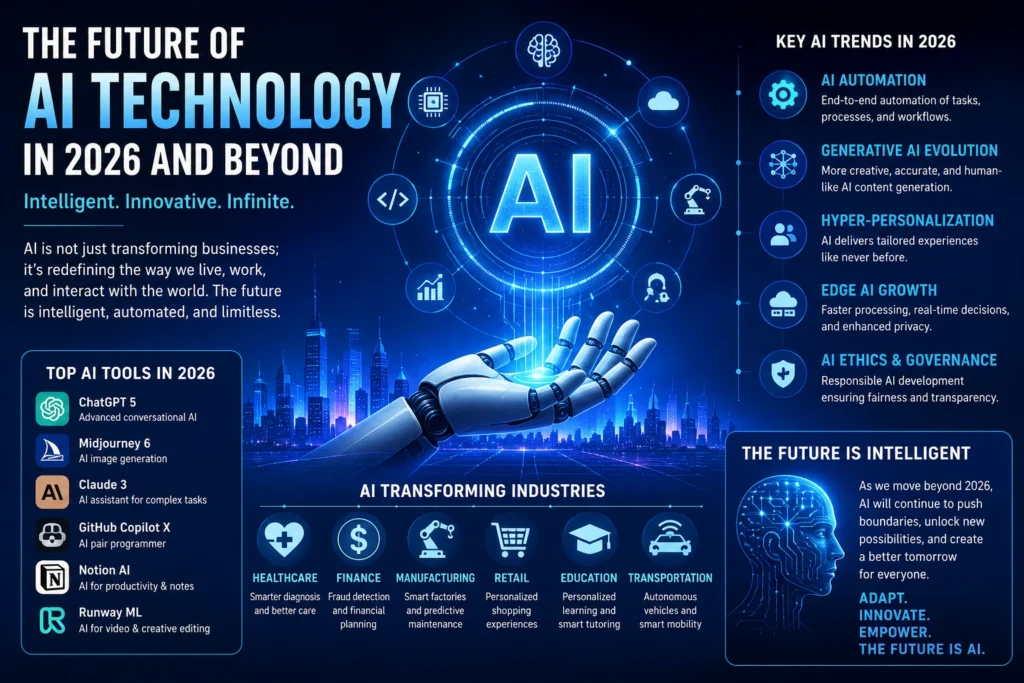
Key Trends in AI Technology in 2026
1. Hyper Automation
Hyper automation is the combination of AI, machine learning, and robotic process automation (RPA). It allows organizations to automate end-to-end processes.
Impact:
- Reduced human intervention
- Increased efficiency
- Faster decision-making
2. AI-Powered Decision Intelligence
AI is no longer just about data analysis; it is about making intelligent decisions.
- Predictive analytics
- Real-time insights
- Business forecasting
These capabilities are driving the adoption of AI Technology across industries.
3. Multimodal AI Systems
Modern AI systems can process multiple types of data simultaneously:
- Text
- Voice
- Images
- Video
This advancement is a cornerstone of the Top AI Tools in 2026, making them more versatile and powerful.
4. Edge AI
Edge AI processes data locally instead of relying on cloud servers.
Benefits:
- Faster processing
- Improved privacy
- Reduced latency
5. AI Ethics and Governance
With increased adoption comes responsibility. Ethical AI is becoming a priority.
- Bias reduction
- Transparency
- Accountability
Role of AI Automation in 2026
Transforming Business Operations
AI Automation is revolutionizing how companies function:
- Automated customer service (chatbots)
- Smart supply chains
- Automated financial analysis
Workforce Transformation
AI is not replacing jobs—it is transforming them.
- Repetitive tasks are automated
- New roles are emerging
- Human-AI collaboration is increasing
Industry-Wise Impact
Healthcare
- AI diagnostics
- Personalized treatment
- Drug discovery
Finance
- Fraud detection
- Algorithmic trading
- Risk assessment
Manufacturing
- Predictive maintenance
- Smart factories
- Quality control
Retail
- Personalized recommendations
- Inventory management
- Demand forecasting
Top AI Tools in 2026
The rise of Top AI Tools in 2026 is making advanced technology accessible to everyone. These tools are designed for:
- Businesses
- Developers
- Content creators
- Marketers
Categories of AI Tools
1. Content Generation Tools
- AI writing assistants
- Image generators
- Video creation tools
2. Business Automation Tools
- CRM automation
- Workflow automation
- Data analytics platforms
3. Development Tools
- AI coding assistants
- Automated testing tools
- Low-code/no-code platforms
4. Marketing Tools
- SEO optimization
- Customer segmentation
- Campaign automation
These tools are accelerating the adoption of AI Technology across sectors.
AI in Everyday Life
Smart Homes
AI-powered devices are becoming standard in households:
- Voice assistants
- Smart appliances
- Security systems
Transportation
- Autonomous vehicles
- Traffic management systems
- Predictive maintenance
Education
AI is transforming education through:
- Personalized learning
- Intelligent tutoring systems
- Automated grading
AI and the Future Workforce
Skills Required in 2026
To thrive in an AI-driven world, individuals need:
- Data literacy
- Critical thinking
- Adaptability
- Technical skills
Human-AI Collaboration
The future is not about humans vs machines—it is about collaboration.
- AI handles repetitive tasks
- Humans focus on creativity and strategy
Job Creation
AI is creating new job roles such as:
- AI specialists
- Data scientists
- AI ethics consultants
Challenges of AI Technology
1. Data Privacy
As AI relies heavily on data, privacy concerns are increasing.
2. Bias and Fairness
AI systems can inherit biases from data, leading to unfair outcomes.
3. Job Displacement
While AI creates jobs, it also disrupts traditional roles.
4. Security Risks
AI systems can be vulnerable to cyberattacks.
Ethical Considerations in AI
Responsible AI Development
Organizations must ensure:
- Transparency
- Fairness
- Accountability
Regulations and Policies
Governments are introducing policies to regulate AI usage.
Trust in AI Systems
Building trust is crucial for widespread adoption of AI Technology.
Future Innovations Beyond 2026
Artificial General Intelligence (AGI)
AGI refers to machines with human-level intelligence. While still in development, it represents the next frontier.
Quantum AI
Combining quantum computing with AI could revolutionize:
- Problem-solving
- Data processing
- Scientific research
AI in Space Exploration
AI will play a key role in:
- Autonomous spacecraft
- Planetary exploration
- Data analysis
AI Technology in Business Strategy
Competitive Advantage
Companies using AI gain:
- Faster insights
- Better decision-making
- Increased efficiency
Digital Transformation
AI is at the core of digital transformation strategies.
Customer Experience
AI enhances customer experiences through:
- Personalization
- Predictive support
- Real-time engagement
The Role of AI in Sustainability
Environmental Impact
AI is helping address environmental challenges:
- Climate modeling
- Energy optimization
- Waste management
Green AI
Efforts are being made to reduce the carbon footprint of AI systems.
AI in India and Global Growth
AI Adoption in India
India is emerging as a major hub for AI innovation:
- Startups
- Government initiatives
- Skilled workforce
Global AI Market
The global AI market is expected to grow exponentially beyond 2026.
Future of AI Automation
Intelligent Process Automation
Future systems will be:
- Self-learning
- Self-optimizing
- Autonomous
AI in Small Businesses
AI tools are becoming affordable, enabling small businesses to leverage AI Automation.
Preparing for an AI-Driven Future
For Businesses
- Invest in AI tools
- Train employees
- Adopt automation strategies
For Individuals
- Learn new skills
- Stay updated with trends
- Embrace change
Conclusion
The future of AI Technology in 2026 and beyond is filled with opportunities and challenges. As AI Automation continues to transform industries and the emergence of Top AI Tools in 2026 accelerates adoption, the world is moving toward a more intelligent and automated future.
AI is not just a technological advancement—it is a paradigm shift that is redefining how we live, work, and interact with the world. Businesses that embrace AI will gain a competitive edge, while individuals who adapt to this change will thrive in the new digital era.
The key to success lies in balancing innovation with responsibility, ensuring that AI is used ethically and for the benefit of society as a whole.